A leg press has no universal empty-sled weight. Match the exact model and its published starting value.
The six models below publish starting values from 60 to 167 lb. These are separate from whole-machine weight and do not by themselves establish physical sled mass.
THE MODEL DIRECTORY
Find your leg press
Match the brand and model code on the equipment label.
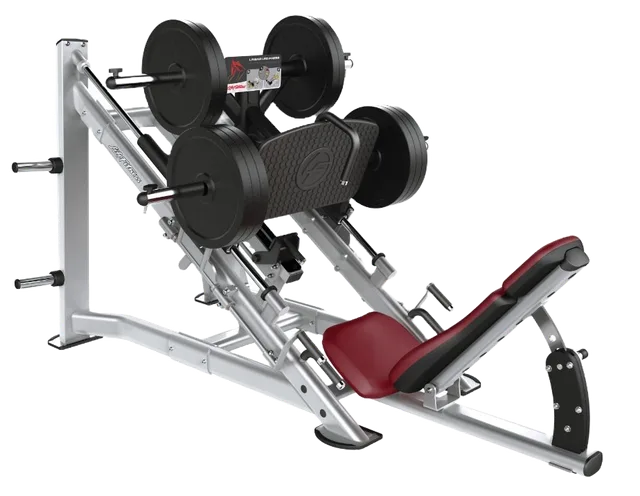
The current Life Fitness specification identifies Product Code SPLLLP and publishes starting resistance separately from the 709 lb / 322 kg whole-machine weight. Signature is the earlier series name used for this code. Match the code rather than the abbreviated name SLLP. The photo includes example plates; these are excluded from the published starting value.
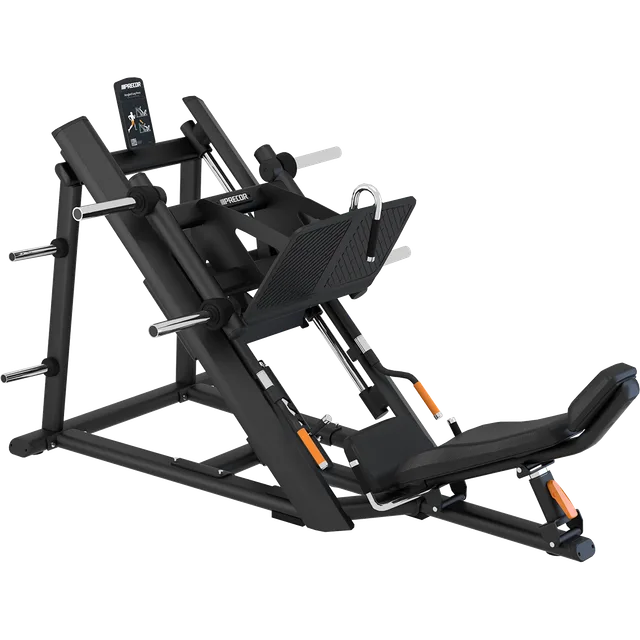
Precor publishes this Starting Weight separately from the 595 lb / 270 kg product weight and 1080 lb / 490 kg maximum lift load. The current product page and model-specific 2026 sell sheet agree. Preserve Precor’s starting-weight label; it does not establish a separately measured physical carriage mass.
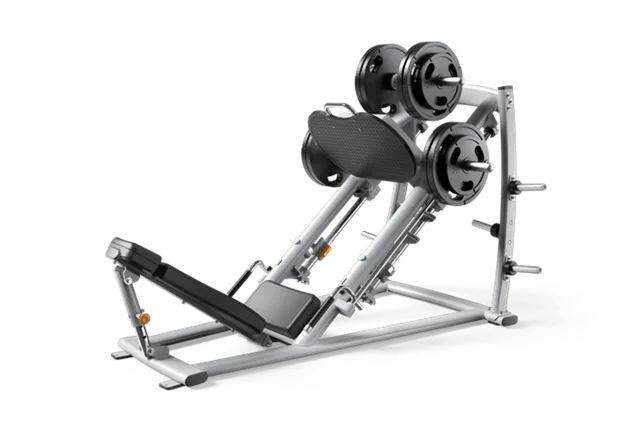
The manufacturer-hosted sell sheet explicitly names MG-PL70 and separates starting resistance from product, shipping and maximum training weights. This is a document-specific model reference; the illustrated machine has six storage horns and example plates. Match the installed unit and its applicable documentation rather than assuming every Matrix leg press uses this value.
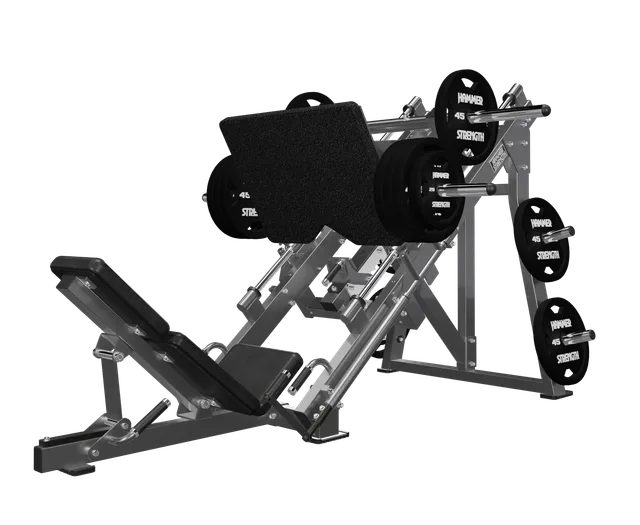
Match the HSLLP model code. This is the linear leg press; other Hammer Strength leg presses use different mechanisms and starting values. The manufacturer image shows example plates, which are not included in the published unloaded starting resistance.
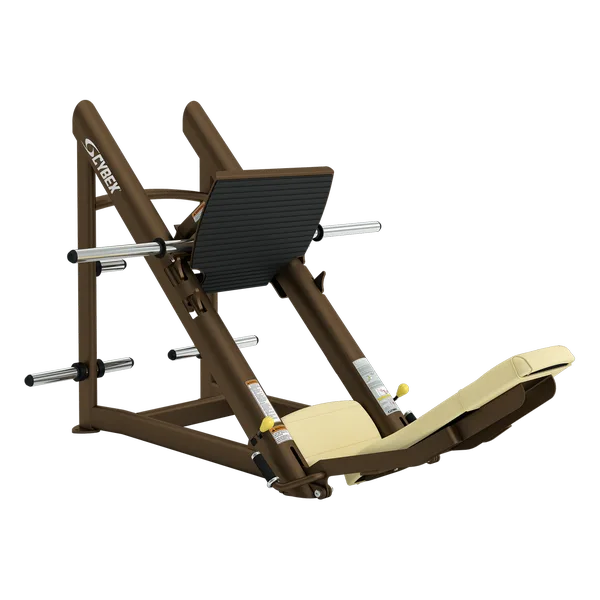
This is a legacy 16110 model reference. The official resistance table labels this pair Take-Off Weight and separately lists a 70% Effective Resistance Ratio in the same row. The starting figure and nominal added plates are not a direct measure of resistance at the feet. Do not apply an extra angle correction to the take-off value or substitute the whole-machine weight from the product page.
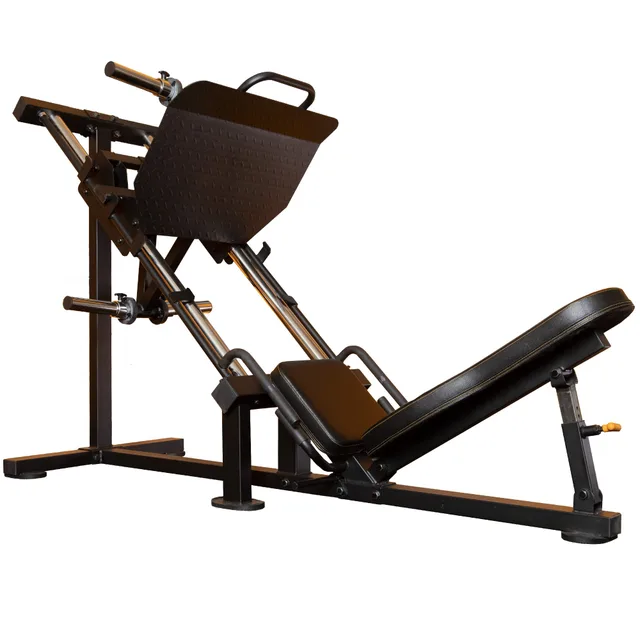
The current P-LP listing identifies SKU P-LP25 and publishes the 60 lb unloaded starting value separately from product weight and capacity. Match your unit’s label; the current product photo does not confirm the specification for earlier versions.
Sources checked
These are manufacturer starting values, with each source’s terminology preserved. They are not whole-machine weights or independently measured sled masses. A nominal logging total is not measured resistance at the feet.
START WITH THE LABEL
Identify your equipment.
Match the exact model before choosing a starting weight.
Find the model code
Read the frame label or equipment placard. Match the full code and the manufacturer, then compare the carriage, foot platform and loading horns with the model image.
Check the weight label
Look for starting resistance, starting weight, unloaded starting weight or take-off weight in that model’s documentation. Product weight, shipping weight and plate capacity describe different quantities.
Keep the same logging convention
Record the plates on the moving carriage’s loading horns on both sides. If you also include the documented starting value, label that convention and use it consistently for that exact machine.
WHAT THE NUMBER MEANS
Starting resistance and machine weight answer different questions
An angled, plate-loaded leg press moves a carriage along rails. Its manufacturer may describe the unloaded starting value as starting resistance, starting weight or take-off weight. This guide preserves the source term rather than treating every published figure as a scale measurement of the carriage.
The whole-machine weight includes the stationary frame and other parts. Maximum plate capacity states how much may be loaded; it is not an empty starting value. Plates parked on fixed storage horns are separate from plates loaded on the moving carriage.
Rail angle, friction and the machine’s mechanism affect how a press behaves. These starting values do not establish a free-weight equivalent, and no angle-based force conversion has been applied. A seated selectorized leg press with a weight stack requires its own model documentation.
For example, Cybex lists a 70% Effective Resistance Ratio separately from the 16110’s take-off weight. Adding a published starting value to nominal plate mass is therefore a logging convention, not a measurement of resistance at the feet. The take-off value is shown as published without any further angle correction.
BEFORE YOUR NEXT SET
Common questions.
Do all leg press sleds weigh 75 lb?+
No. The exact models in this guide publish different starting figures, including 60 lb for the current Powertec P-LP listing and 167 lb for the documented Matrix MG-PL70. A generic number cannot identify an unknown machine.
Is starting resistance the same as the physical sled weight?+
Do not assume that. Starting resistance describes the manufacturer’s published starting value for that machine. A physical carriage mass is a separate measurement unless the manufacturer explicitly identifies it that way. The source labels are shown with each model.
Do I count the plates on both sides?+
Count all plates loaded on the moving carriage’s working horns on both sides. Keep plates stored on stationary storage horns out of that total. Record whether your training log contains plates only or plates plus the model’s published starting value. That sum is a nominal logging convention, not measured resistance at your feet.
Can I compare that total directly with a squat or another leg press?+
A nominal training-log total is not a free-weight equivalence. Machine mechanisms, rail angle and friction differ. Use the same machine and the same logging convention when comparing your entries.
What if my leg press is not listed?+
Check its exact model label and manufacturer manual, or ask the gym for the matching specification. Leave the empty starting value unknown until it is documented; do not substitute a nearby-looking model.
Does the weight stack on a seated leg press use these values?+
No. These records concern the named plate-loaded leg presses. Selectorized machines use their own mechanisms, stack labels and manufacturer specifications.
SOURCES, NOT GUESSWORK
How this guide is compiled.
Each entry retains the manufacturer’s original label and published unit pair. Where only one unit is published, the converted value is marked ≈.
The Cybex 16110 is a legacy reference supported by an official model-specific resistance-table row. The Matrix record is supported by a manufacturer-hosted MG-PL70 sell sheet. Neither record makes a current retail-availability claim.
Model photos may show example plates. Those plates do not change the cited unloaded starting value. Image identity and model codes help identify equipment, but do not establish an undocumented revision cutoff.
Source pages and documents were checked on 28 October 2026. No rail-angle conversion, physical-sled-mass inference or free-weight equivalence was calculated.